The Internet Changed Before We Understood What It Was Becoming
Operation Cathedral, safeguarding history, and why the current online-safety debate increasingly misses the deeper problem

The Investigation That Changed Everything
In the late 1990s, British investigators uncovered something hidden inside the early internet that would fundamentally change how governments understood online harm.
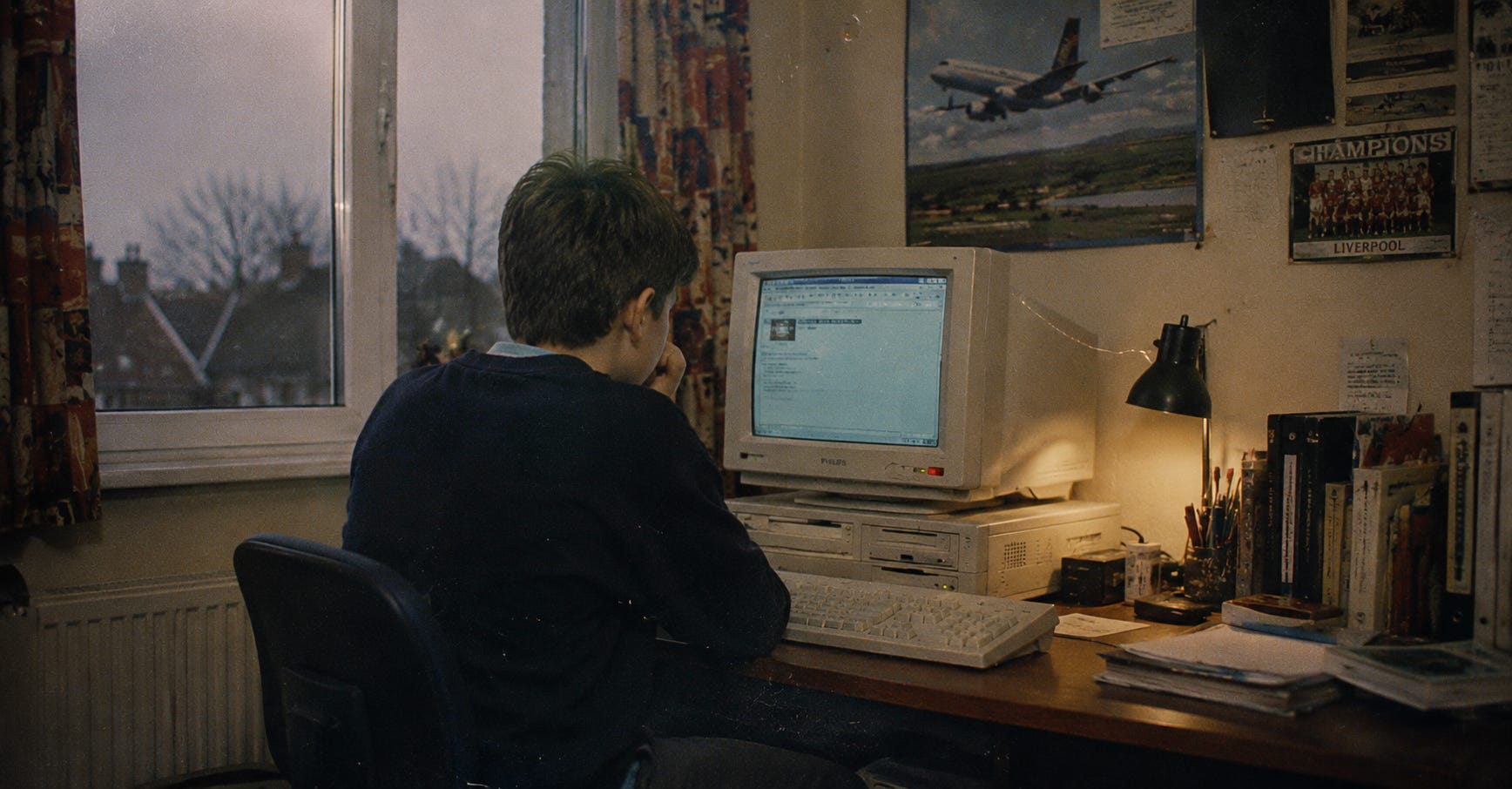
The investigation became known as Operation Cathedral.
At the centre of the operation was an international online network known as the Wonderland Club, a hidden community operating through password-protected forums and anonymous identities during the earliest years of the public internet. Members distributed abusive material, exchanged information, coordinated activity internationally, and operated largely beyond traditional institutional visibility. This was before smartphones, before social media feeds, before recommendation algorithms, and before artificial intelligence entered ordinary life.
At the time, the internet still felt slow, technical, and strangely innocent.
Families connected through noisy dial-up modems that occupied household phone lines. Parents bought home computers believing they were educational. Schools spoke about digital futures with optimism. Chat rooms and message boards were becoming popular, but the language we now use constantly, online grooming, behavioural manipulation, algorithmic amplification, digital radicalisation, barely existed in mainstream public discourse.
Most adults simply did not understand what the internet was becoming. Governments largely viewed it as infrastructure: a communications tool sitting on top of ordinary life rather than an environment capable of reshaping human interaction itself. Then investigators from the UK’s National Crime Squad discovered hidden online communities operating internationally through anonymity, secrecy, reinforcement, and coordinated exploitation.
One of the moments that accelerated the wider international investigation involved the live-streamed abuse of an eight-year-old girl over the internet while offenders watched remotely and encouraged the assault in real time. That detail matters because it completely changes the historical context of today’s debate.
Long before modern social-media platforms existed, investigators were already confronting digitally mediated exploitation operating across borders under conditions of anonymity and fragmented visibility.
The victims were not statistics.
They were children growing up inside a new kind of environment society itself barely understood yet.
At the time, many parents still viewed the internet as educational, technical, or harmlessly experimental. Children used chat rooms and online services from family homes while parents often had little understanding of who they were interacting with, how identities could be concealed online, or how hidden communities were already forming underneath the surface of the early web. For investigators, the discovery was deeply alarming not simply because of the criminality itself, but because of what it revealed structurally.
The internet had removed geography.
Offenders no longer needed to operate locally. Hidden communities could now form internationally, persist continuously, reinforce behaviour collectively, and remain largely invisible to traditional policing structures built around physical locations, observable communities, and geographically constrained offenders.
Modern cyber forensics barely existed. Investigators manually traced digital evidence across multiple countries while governments themselves were still trying to understand what the internet was becoming. Computers were seized. Deleted material was recovered. Hidden online identities were painstakingly linked back to real individuals. Victims were identified across multiple jurisdictions.
The resulting convictions did not simply put offenders behind bars. They shattered the illusion that digital distance provided anonymity without consequence.
Public reaction at the time was a mixture of shock, confusion, and disbelief. For many people, the internet had still largely been perceived as futuristic, educational, and commercially exciting. The idea that hidden international exploitation networks were already operating inside these emerging digital environments was deeply unsettling. But society still largely interpreted the issue through the lens of criminality and illegal material.
What far fewer people yet understood was that the internet itself was beginning to evolve from a communications system into something far more psychologically immersive. That distinction may be one of the most important and least understood transitions of the modern era.
The Pattern We Still Haven’t Fully Understood
Looking back now, what is striking is how familiar many of the dynamics revealed during Operation Cathedral still feel today. Anonymous identities. Hidden communities. Manipulation operating privately beyond ordinary visibility. Reinforcement unfolding inside environments parents, schools, and institutions struggled to fully see or understand.
The technologies changed dramatically over the next twenty-five years.
The underlying human dynamics changed far less.
That is why many modern debates around online harm increasingly feel incomplete. The discussion often collapses into highly binary positions: social media versus children, phones versus mental health, regulation versus free speech, platforms versus parents. Comparisons are frequently drawn with the tobacco industry, implying digital platforms function primarily as harmful products requiring stronger restriction and liability.
There is truth within that comparison. Platforms absolutely amplify immersion, emotional dependency, psychological reinforcement, and social influence at unprecedented scale. But the comparison is also structurally incomplete.
Cigarettes do not adapt. Human systems do.
The internet did not create coercion. It did not create predatory behaviour. It did not create manipulation. It did not create exploitation. Human beings did that long before the internet existed.
What technology changed was the scale, persistence, anonymity, accessibility, and invisibility through which those behaviours could now operate. The dark web strengthened anonymity. Social media mainstreamed immersion. Smartphones made digital identity continuous. Artificial intelligence may now industrialise synthetic manipulation itself. But the underlying architecture was already visible during the earliest years of the public internet.
That is the part history makes difficult to ignore.
Safeguarding Has Seen This Pattern Before
In many ways, this follows a much older historical pattern. For most of modern British history, safeguarding evolved around environments society could physically observe: homes, schools, families, and communities. Harm was still often hidden, but the environments themselves remained visible.
· The Children and Young Persons Act 1933 focused primarily on visible abuse, neglect, and physical cruelty.
· Wartime evacuations during the Second World War exposed hidden neglect and abuse inside ordinary homes that institutions had previously failed to see.
· The death of Dennis O’Neill forced Britain to confront failures in foster-care oversight.
· The murder of Maria Colwell exposed catastrophic failures in information-sharing between agencies already aware of risk.
· The Children Act 1989 shifted safeguarding further toward emotional wellbeing and developmental harm.
· The deaths of Victoria Climbié and Baby P again revealed systems where multiple agencies each held fragments of visibility but failed to connect them in time.
The pattern is remarkably consistent.
Major safeguarding reforms usually arrive after society realises existing systems were seeing harm too late. Digital environments changed that relationship entirely.
Today, interactions increasingly occur privately inside encrypted systems. Manipulation develops gradually rather than explicitly. Synthetic identities complicate attribution. Parents, schools, platforms, police, and safeguarding agencies often each see only fragments of a much larger picture. We are now trying to police a hyper-connected, algorithmic world using visibility models largely designed for the era of the neighbourhood watch.
The environment evolved faster than the visibility model. That may ultimately be the real lesson connecting Operation Cathedral to the present day. Not that technology suddenly became dangerous. But that digital environments evolved into socially immersive systems faster than institutions, governments, and societies fully understood the implications of living inside them.
The Real Challenge Is Upstream Visibility
The question, then, is not whether societies should simply become more technologically restrictive. Nor is it whether platforms alone should carry the entire burden of responsibility.
The deeper challenge is whether safeguarding systems built around explicit evidence and downstream visibility can still operate effectively once harmful trajectories increasingly form upstream of obvious intervention thresholds. Historically, institutions intervened once harm became visible: a visible injury, a disclosure, an identifiable offender, a criminal image, a direct threat.
But exploitation rarely begins at the point society finally recognises it. It develops gradually through interaction, trust formation, coercion, dependency, secrecy, emotional manipulation, reinforcement, and escalating isolation long before a single moment clearly announces itself as dangerous.
That is what makes modern digital environments so difficult to govern.
The challenge is no longer simply detecting explicit harmful content once it appears. It is the difference between waiting for evidence of harm after escalation and recognising patterns of grooming, dependency, secrecy, and isolation before crisis becomes explicit.
That does not require abandoning privacy. If anything, the opposite may be true.
The more psychologically immersive digital environments become, the more important it becomes to develop safeguarding models capable of operating under conditions of partial visibility rather than assuming unrestricted access to human communication itself. No single institution will ever hold complete visibility inside modern digital environments. Parents see fragments. Schools see fragments. Platforms see fragments. Law enforcement sees fragments. Safeguarding professionals see fragments.
Which means safeguarding increasingly becomes a problem of partial signals, contextual interpretation, and coordinated response rather than centralised control. The roadmap forward is unlikely to emerge from any single intervention alone. It will require layered safeguarding models capable of combining human judgement, behavioural context, privacy-preserving signal analysis, institutional coordination, and proportionate escalation without collapsing into either mass surveillance or institutional blindness.
Continuing to rely entirely on downstream visibility in environments increasingly shaped by encryption, anonymity, immersion, and AI-mediated interaction is becoming progressively harder to defend. Societies repeatedly realise harm was forming long before existing systems were designed to properly see it.
The uncomfortable possibility is that we may be approaching another one of those moments now.
Why I Keep Coming Back To This
My interest in this subject is not ideological. I am neither fundamentally anti-technology nor blindly optimistic about it.
There are legitimate concerns on all sides of the current debate: privacy, state overreach, platform accountability, free expression, surveillance, child protection, parental responsibility, and the developmental impact of persistent digital immersion. To be objective requires examining those tensions honestly.
But my own focus increasingly comes back to one underlying question: How do societies reduce preventable downstream harm if harmful trajectories are increasingly forming before explicit visibility exists?
That, ultimately,is why I have spent the past several years focused on earlier safeguarding visibility. Not because I believe technology itself is inherently good or evil. But because safeguarding history repeatedly shows the same pattern emerging across generations:
harm often develops gradually, relationally, and invisibly long before institutions clearly recognise the trajectory unfolding in front of them.
And if Operation Cathedral revealed anything more than twenty-five years ago, it may be this: the greatest danger was never simply what the internet allowed people to see.
It was how quickly it changed the conditions under which harmful human behaviour itself could hide, scale, and evolve before society fully understood what it had become.
The “upstream visibility” idea really stayed with me. So much of how we try to keep people safe only kicks in once something’s already happened, an image or a disclosure, but grooming and radicalisation aren’t single moments. They build slowly, and it’s a process, That’s the really tricky bit your piece gets at. How do you spot something forming without watching everyone? I think you’re right that the honest answer sits somewhere in the middle, piecing together small signals rather than swinging to either extreme. Really appreciated you not reaching for the easy either/or here. As always, a great piece.