Encryption Is Not the Problem. Visibility Is.
Encryption did not create the safeguarding problem. It exposed it

Weakening encryption may increase visibility, but it does not solve how digital harm actually develops. The debate around encryption, child safety, and platform responsibility is intensifying again.
Governments are demanding greater visibility into private communications. Platforms are being pressured to detect grooming, coercion, sextortion, and harmful behaviour earlier. At the same time, encrypted messaging is becoming the default architecture of the modern internet.
The assumption underneath this debate is rarely questioned: If platforms can inspect communications, they can stop harm. That assumption no longer holds.
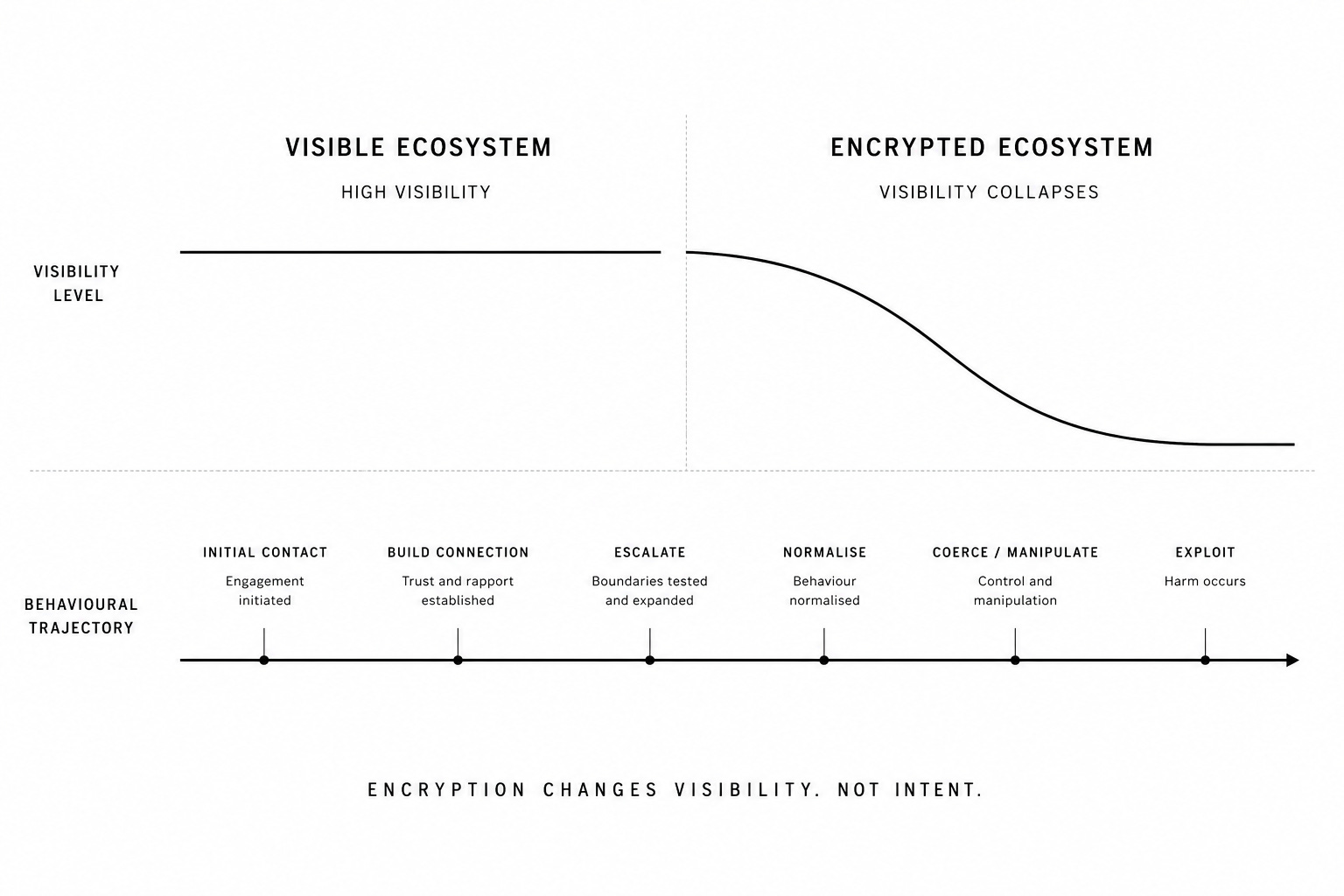
Traditional moderation models were built for a different internet.
They were designed around:
· visible platforms
· centralised communication
· explicit content
· server-side moderation
In that world, harmful material could be detected through keywords, images, reporting systems, or known signatures. But behavioural exploitation has evolved. Harm no longer emerges primarily through isolated content.
It develops through:
· trajectory
· escalation
· coercion
· manipulation
· behavioural conditioning over time
That changes the problem fundamentally. A predator adapting to inspection does not simply stop. They migrate. They fragment communication across platforms.
They move towards:
· encrypted applications
· gaming environments
· peer-to-peer communication
· voice interaction
· ephemeral messaging
· AI-generated identities
Visibility pressure does not eliminate predatory behaviour. It redistributes it. This is the contradiction now emerging across the internet.
Governments increasingly want visibility. Encryption increasingly removes it.
At the same time, weakening encryption creates security risks of its own. Encryption exists because centralised inspection and visibility create:
· abuse potential
· insider risk
· surveillance concerns
· attack surfaces
· systemic vulnerability
From a cybersecurity perspective, weakening encryption has always been dangerous. The internet is now moving from inspectable platforms towards encrypted personal ecosystems at the same moment that artificial intelligence is making manipulation:
· cheaper
· more scalable
· more believable
· more adaptive
That is why governments are becoming increasingly uncomfortable. Their historical enforcement model depended on visibility. Visibility is disappearing.
The regulatory response is now becoming increasingly conflicted. Under GDPR, UK GDPR, ePrivacy principles, and broader privacy jurisprudence, there are significant legal and ethical concerns around:
· indiscriminate inspection
· continuous monitoring
· large-scale processing of private communications
· opaque AI inference systems
· profiling minors at scale
The same systems designed to protect children can also become systems of continuous inspection. That is the tension. The problem is often framed as a binary choice between privacy and safety. It is not.
The real challenge is whether safeguarding can evolve without undermining the security architecture modern communication now depends on. At a structural level, there are really only four models:
Full encryption with no safeguarding layer Privacy preserved visibility collapses
Full inspection and surveillance. Visibility improves, privacy collapses
Traditional platform moderation Reactive and incomplete
Privacy-preserving behavioural safeguarding. Technically difficult, but potentially the only sustainable balance
This is where the debate is likely heading. Not towards unrestricted surveillanc and not towards unrestricted invisibility. But towards:
· on-device safeguarding
· behavioural inference
· bounded intelligence
· proportional escalation
· privacy-preserving AI
· human-centred intervention models
The future of safeguarding may depend less on inspecting everything…and more on understanding how harm develops before anything explicit appears.